something unusual caught my attention.
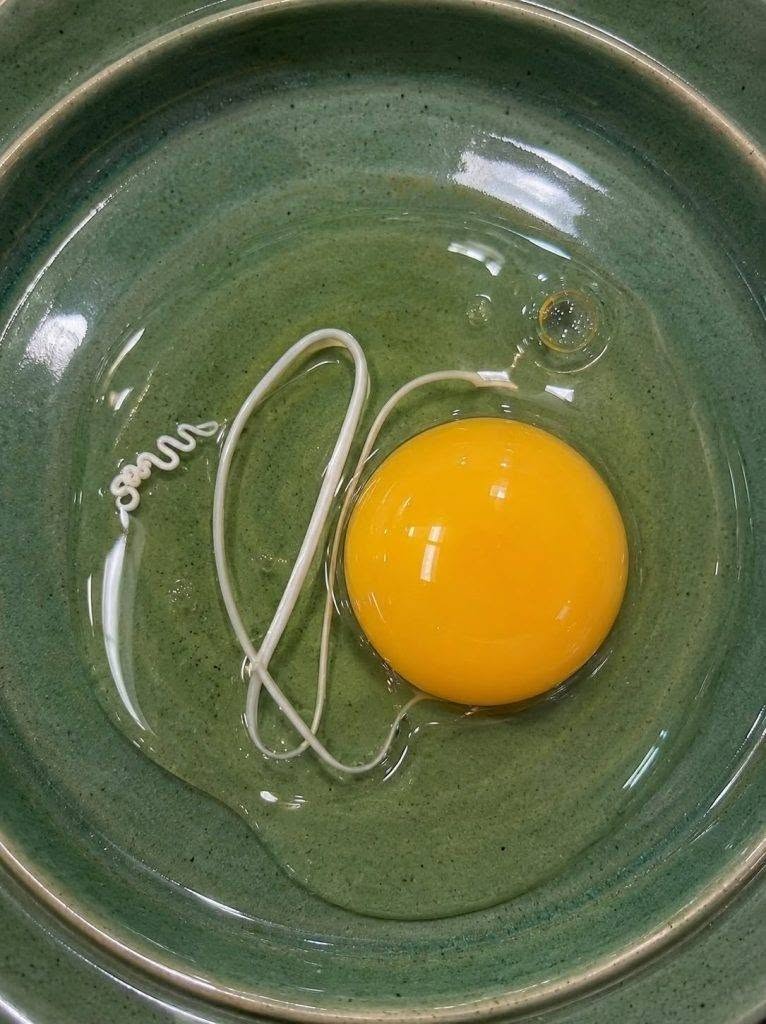
As I cracked an egg into a bowl, I noticed a strange white strand running through the egg white. It was thin, slightly twisted, and looked almost like a tiny piece of string or a worm. My stomach immediately tightened. I froze, spatula in hand, and stared at the bowl as if it contained something dangerous.
I did what almost everyone does when they’re worried about food: I immediately assumed the worst.
Was it a parasite? A worm? Some kind of contamination?
I thought about salmonella warnings, food recalls, and all the things I’d read online about food safety. I could feel my appetite disappearing.
I almost threw the whole thing out. I was this close to throwing away the bowl, the egg, and the entire idea of breakfast.
But something stopped me. Maybe it was my natural curiosity. Maybe it was the fact that I’d already poured my coffee and wasn’t ready to give up on breakfast.
So I pulled out my phone and started researching.
Twenty minutes later, I was laughing at myself.
Because that white string—the one I thought might be a parasite or some kind of contamination—is completely natural. It’s not a worm. It’s not dangerous. And I’d been eating it my entire life without ever realizing what it was.
Let me tell you what it actually is, why it’s there, and why you don’t need to worry when you see one.
What Is That White String in Your Egg?
That white, twisty, slightly opaque strand is called the chalaza (pronounced kuh-LAY-zuh). The plural is chalazae.
The chalaza is a cord-like structure made primarily of egg-white proteins. There are usually two of them, and they help keep the yolk centered within the egg.
Think of them as tiny suspension cords. They anchor the yolk and help keep it from moving around too much inside the egg.
The chalaza is completely edible and safe to eat. In fact, a prominent chalaza can be one indication that an egg is relatively fresh.
As an egg ages, the albumen (egg white) becomes thinner and the chalaza may become less noticeable. That’s one reason you may see a more prominent chalaza in a very fresh egg.
The word “chalaza” comes from the Greek word khalaza, meaning “hailstone,” referring to its appearance.
Why You Probably Never Noticed It Before
see continuation on next page